What on a Jewish Corn Beef Special Show Picture?
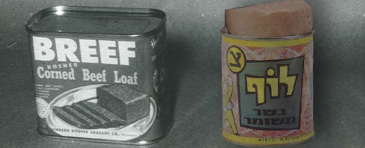
On Nov. xiv, 2011, the Israeli media outlet Ynet sounded the expiry knell for a staple of the country'south armed forces diet: Loof, Israel's kosher alternative to Spam.
Thanks to a policy of mandatory conscription, the Jewish state in event, had been forcefulness-feeding Loof — a colloquially corrupt short course of "meatloaf" — to its citizens since the nation'southward founding. The resulting trauma alluded to in Gil Marks' "Encyclopedia of Jewish Food" (2010) is understandable:
Many Israeli soldiers insist that Loof uses all the parts of the cow that the hot canis familiaris manufacturers will not accept, but no one outside of the manufacturer and the kosher supervisors actually know what is inside. (Marks 369)
Loof anecdotes are ubiquitous and diverse. A personal favorite that emerged while researching this topic was a current twenty-yr-old Israeli soldier who was handed a can of meat dated 1988. "Information technology wasn't bad," the soldier said. "Information technology only felt weird eating something that was older than me."
"Loof has a worse proper name than it deserves," State of israel's national archivist, Yaacov Lazownik, responded in an electronic mail. "Everyone I've mentioned this to recently comes up with a story along the lines of, 'The Loof was commonly atrocious, but nosotros had this i guy who knew how to cook it so that it was succulent …' "
[[READMORE]]
Canned meats and the military have enjoyed a symbiotic human relationship for at least a century — ditto for kosher canned meats.
"In the late 1940s," begins the entry for Loof in Marks' encyclopedia, "the Israeli Defense Forces developed a kosher grade of the British 'Bully beef.' "
Bully beef, a generic term used to describe canned meat in Britain, was served to British troops every bit early as the Second Anglo-Boer War at the turn of the 19th century. In an unrelated development around that time, protests by animal rights groups in Germany and Switzerland led those governments to consider prohibiting the practice of shechitah, Jewish ritual slaughter that distinguishes kosher meat.
In 1894, Dr. Isaac Dembo, a Russian physician, began to study and publish works near the science of shechitah. Dembo set out to demonstrate that shechitah should non merely be tolerated; he argued that it represented an comeback over existing slaughter methods in terms of hygiene and humane handling of animals. V years afterwards the Hebrew-linguistic communication periodical HaTsefirah extolled Dembo'south efforts:
And who doesn't know that from the moment the value of schechita was made known to all by the books of Dr. Dembo, a constabulary was given in Spandau next to Berlin by the government minister of state of war to set canned meat for troops just from animals slaughtered through shechita?
Every bit is the case with many industries, wartime proved to be a boon for canned meats. Introduced in 1926, Hormel Spiced Ham — meliorate known as Spam — originally marketed its canned meat based on the novelty and convenience that it did non require refrigeration.
"This didn't make the ground meat more attractive," Israeli writer Sagi Cohen commented in a 2010 natural language-in-cheek mag article. "Mountains of these cans were piling up in the company's warehouses, until in 1939, a miracle happened to [Hormel]: Hitler invaded Poland."
Just as Spam benefited from the war endeavor — supplying 15 million cans weekly to Allied forces — the demand for kosher canned meats also began to increase. The wartime office of kosher canned meat was first mentioned by JTA in a 1942 commodity about Hadassah sending food to Palestine from the U.S. Before the state of war, JTA also had a couple of references to canned meat: During a 1930 tax dispute between a Jewish slaughterhouse in Palestine and the British Mandate, "the use of canned meat was resorted to past some while patients in the hospitals suffered from the lack of fresh meat." In 1933, JTA reported that kosher canned meat would not be on the menu of rations during the Low.
The real boom in kosher canned meats took place when kosher canned meat became a crucial component of Jewish organizations' relief packages for Europe'south Jewish war victims. JTA first noted this at the finish of 1945, when the American Jewish Joint Distribution Committee fabricated canned meat available in DP camps in Deutschland.
In May 1946, the Chicago Kosher Sausage Manufacturing Company — a Winnipeg-based company — registered a word marker with the Canadian patent role for a canned meat product called Breef.
Neil Feinberg, 74, the terminal owner of the Feinberg Sausage Co. in Minneapolis, says he'southward well familiar with Breef.
"That was the best quality production of the bunch" among kosher canned meats, he says.
"Canned corned beef is like Spam — very similar texture," explained Feinberg, 74, who is retired and living in Palm Springs, Fla. "Simply it was fabricated of beef and had a corned beef season to it," an effect accomplished by using the same seasoning from the company'south regular corned beef.
Kosher canned meats weren't limited to corned beef. Feinberg, whose company was started in 1890 by his cracking-granddaddy, a Russian rabbi, as a kosher salami performance, also produced canned salami. In Pittsburgh, the Jan. ii, 1953 edition of the Jewish Chronicle heralds the arrival of a new product by the Penn Kosher Food Company: a iv ane/2-pound "whole craven in a can."
But Breef, Feinberg says, was top of the line.
Whether the Breef sold in Minneapolis was the same as the i sold in Winnipeg is unclear. But certainly information technology'due south feasible: Winnipeg and Minneapolis are almost 450 miles apart, and the Averbuch family that owned Chicago Kosher were friends of the family, Feinberg recalls. Other products, like sliced beefiness bacon, were fabricated under both labels.
Whatever the case, Breef began selling fast at habitation and overseas. Early in 1947, the Feinberg Sausage Co. announced that it would be introducing Breef to the Minneapolis-St. Paul market place with a 13-week advertizing campaign through radio and display ads, along with a recipe contest. According to Feinberg, the product eventually was distributed in North Dakota, South Dakota, Iowa and afterward California.
On March 7, 1947, JTA reported a shipment from the Canadian Jewish Congress, the United Jewish Relief Agencies of Canada and the JDC that contained ane million pounds of kosher canned meat designated for Jewish war victims in Europe. "The meat is beingness canned in Winnipeg according to Jewish dietary laws," said the report.
In a collection of Chicago Kosher Sausage'southward documents — located today in the Jewish Historical Society of Western Canada — a Nov. 27, 1947 letter of the alphabet from the executive manager of CJC's Western Partition offers anecdotal insight as to how the production was received:
One of the tins of corned beef was sent to a Hungarian Jew who, you may exist pleased to acquire, liked it so much that he wants more. He too indicated that parcels with other nutrient-stuffs would be gratefully accepted.
In 1950, JTA reported that this "ane Winnipeg company" was doing $two.5 million worth of kosher canned meats exports to Israel.
Alas, the glory days of kosher canned meat were relatively short lived following the war. One year before the May 1950 JTA article was published, a distress signal was sent in the grade of a letter from A. Averbuch to the kosher supervising agency, the Va'ad Ha'ir of Winnipeg:
We exceedingly regret to advise you that due to lack of export concern in our canning department, we are compelled to be more than or less shut down for an indefinite period.
Due to the higher up circumstances, we are not in a position to pay our present monthly rate to you, and therefore would appreciate a private coming together with us to discuss the new arrangement.
A letter of similar tone sent to the Va'advertisement Ha'ir on July 13, 1951 described a "quite desperate" situation, where 75 percentage of its 52 employees were laid off. In contrast to a letter sent 2 months earlier, "the by several months nosotros have not produced anything in Canned Meats, nor is in that location anything in the offing," wrote Averbach.
One factor that may have contributed to the demise of Winnipeg's kosher canned meat operation was increased competition in Europe. A July 23, 1948 acceleration announcing the opening of an Israel trade mail in London notes that the Jewish state had already been bartering citrus fruit for Ireland'due south canned meat. The annual report of Ireland'due south government minister of agriculture dated 1948-1949 notes that approximately 27 percent of canned stewed steak shipped to Europe was "Kosher canned stewed steak for the relief of distressed Jews," calculation that "the tinplate for the cans was supplied by the Jewish System concerned in the distribution of the Kosher meat." In 1949, an Israeli rabbi prepare out to oversee a kosher meat-canning plant in Poland.
As described in the book "Coming of Age: A History of the Jewish People in Manitoba," the Winnipeg company went out with a heartwrenching thud that reverberated throughout the Jewish community. In 1970, 90 percent of a beefiness shipment destined for Winnipeg's Chicago Kosher plant was discovered to be non-kosher meat from New Zealand. While the company and owner were ultimately assessed a small fine, their refusal to apologize tainted any addicted memories of meat might accept otherwise lingered.
In Minneapolis, the Feinberg family business concern ceased canning operations in 1955 due to a lack of demand. Six years later the company was sold to Sinai Kosher.
"The problem with Feinberg Kosher Sausage," said Feinberg, "was that we were in a small marketplace. It was hard to compete against big kosher sausage factories in Chicago," which had direct admission to slaughterhouses.
"But nosotros had a good make," he added proudly.
****
The demand to supervene upon Loof was accelerated by the realization in 2009 that the longtime manufacturing company Richard Levy, which had declared bankruptcy early in the 2000s, had stopped producing new cans. Upon making the discovery, the military realized it was now running solely on inventory.
After a yr of market testing with soldiers and making packaging refinements, the IDF announced last week that "ground meat with tomato sauce" was selected among three varieties of kosher meals ready-to-eat (MREs) to replace Loof. Kosher MREs, which have been produced for the U.S. war machine since 1996, come with special aluminum numberless that melt contents through chemic reaction upon contact with h2o.
With the sun setting on Loof — the last groovy vestige of kosher canned meats — Jewish readers can look to Africa for the futurity of traditional canned meats:
Over the summer, the Kenya Meat Commission designated 600,000 tins of halal canned corned beefiness for famine relief.
[Photo courtesy of the Jewish Historical Society of the Upper Midwest]
Source: https://www.jta.org/2011/11/20/default/kosher-spam-a-breef-history

Post a Comment for "What on a Jewish Corn Beef Special Show Picture?"